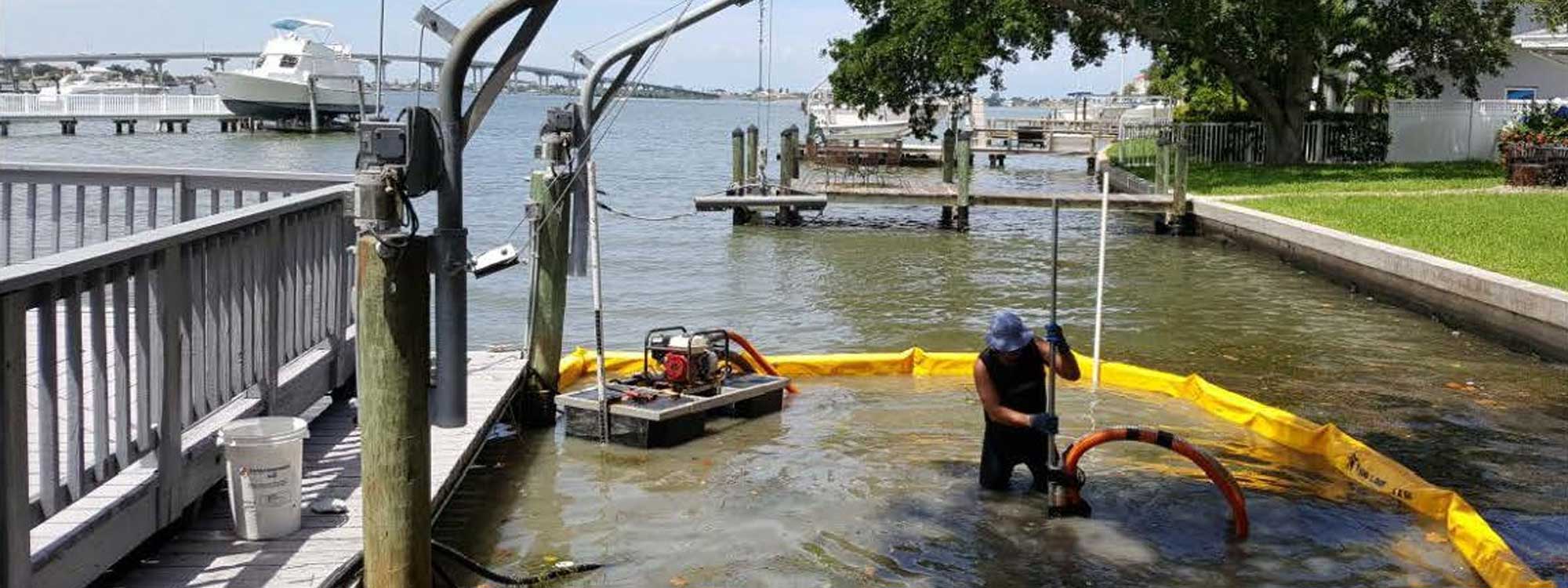
Questions or concerns for residential and commercial dredging projects.
Do you need permits for boat slip dredging, boat lift dredging and canal dredging?
Yes - Depending on location, acquiring the correct municipal, county, state, and federal permits are required prior to dredging. An exemption does not excuse the homeowner from obtaining permits. Ignoring to do so can produce multiple fines and/or fees to the homeowner.
What is needed in the permit process?
Putting together a permit package and submitting the package to the correct department(s). The permit package includes, but is not limited to, the project area, volume, disposal location and dredge methodology.
What is involved in calculating an accurate volume and dredge depth?
A bathymetric survey or “in-water survey” of the proposed and surrounding dredge limits in the NAVD-88 datum. The NAVD-88 datum survey points are then converted to the Mean Low Water (MLW) datum, to relate the water elevations to a zero tide. A proposed surface of the proposed dredge design is then created and compared to the current existing bottom surface. When both surfaces are compared, it calculates the volume (cu. yds.) of removal needed for the area and depth of the proposed dredge design. Software programs such as Autodesk AutoCAD Civil3d and/or HYPACK are used.
What is mean low water (MLW)?
"The average of all low water heights observed over the National Tidal Datum Epoch." 1
How are survey elevations collected?
Trimble GPS equipment plays a vital role in topographic data collection using an integrated GNSS system to accurately collect points in XYZ positions. Once the data has been collected, it’s exported in a format that allows to import/plot the points into Civil3D and/or HYPACK software programs.
Our company’s main objective is providing exceptional services to homeowners or businesses that are interested in dredging activities.
For any other questions or concerns on the subject matter of permits or dredging, please feel free to contact Bayside Dredging LLC and we’d be happy to go over in more detail.
1 NOAA Tides & Currents. MLW (Mean Low Water) - read more